China Household Registration (Hukou) Notarization & Apostille for Use in Singapore: Complete Guide
When applying for a Dependent Pass (DP), Long-Term Visit Pass (LTVP), registering a marriage, or supporting a visa application in Singapore, ICA and other Singapore government authorities typically require a notarized and apostilled copy of the Chinese household registration booklet (hukou) as proof of the family relationship between the applicant and the sponsor. This guide explains the full translation, notarization, and apostille process, and what you need to prepare.
1. Why Does the Hukou Need Translation, Notarization, and Apostille?
The Chinese household registration booklet is a Chinese-language document issued by the Chinese government. Singapore government authorities cannot independently verify its authenticity, nor can they read its contents. For the hukou to be accepted in Singapore, it must go through the following three steps:
Professional English translation
→
Bilingual notarization (CN + EN bound together)
→
Apostille
Once all three steps are complete, the document submitted to Singapore authorities contains both the original Chinese content and its certified English translation in a single notarized and apostilled booklet — no separate verification of the original is required. Lervice provides translation, notarization, and apostille as a complete one-stop service.
If the applicant and sponsor are registered in different hukou booklets: If proving the family relationship requires showing that two people are related (for example, parent and child, or spouses), but they are registered in separate household booklets, both complete hukou PDFs must be provided. We will bind the content of both booklets — together with their translations — into a single notarization booklet, presenting the full family relationship chain in one document.
2. Step-by-Step Process
Submit hukou PDF
→
Lervice arranges English translation
→
Bilingual notarization (CN + EN)
→
Apostille
→
Collect or courier delivery
3. Documents Required
Single hukou booklet (applicant and sponsor in the same household registration)
- Complete hukou booklet as a PDF (all pages included)
- Copy of the applicant's passport or Singapore NRIC/FIN
Multiple hukou booklets (applicant and sponsor in different household registrations)
- Complete PDF of the applicant's hukou booklet
- Complete PDF of the sponsor's hukou booklet
- Copy of the applicant's passport or Singapore NRIC/FIN
- Both booklets will be bound together in a single notarization booklet to present the full family relationship
Why is the entire booklet required rather than selected pages? The pages of a household registration booklet are interconnected — the household head page records the family unit's basic information, and each member page records the individual's relationship within the household. Submitting only selected pages may prevent the receiving authority from verifying the complete family relationship. Providing the full booklet avoids this issue.
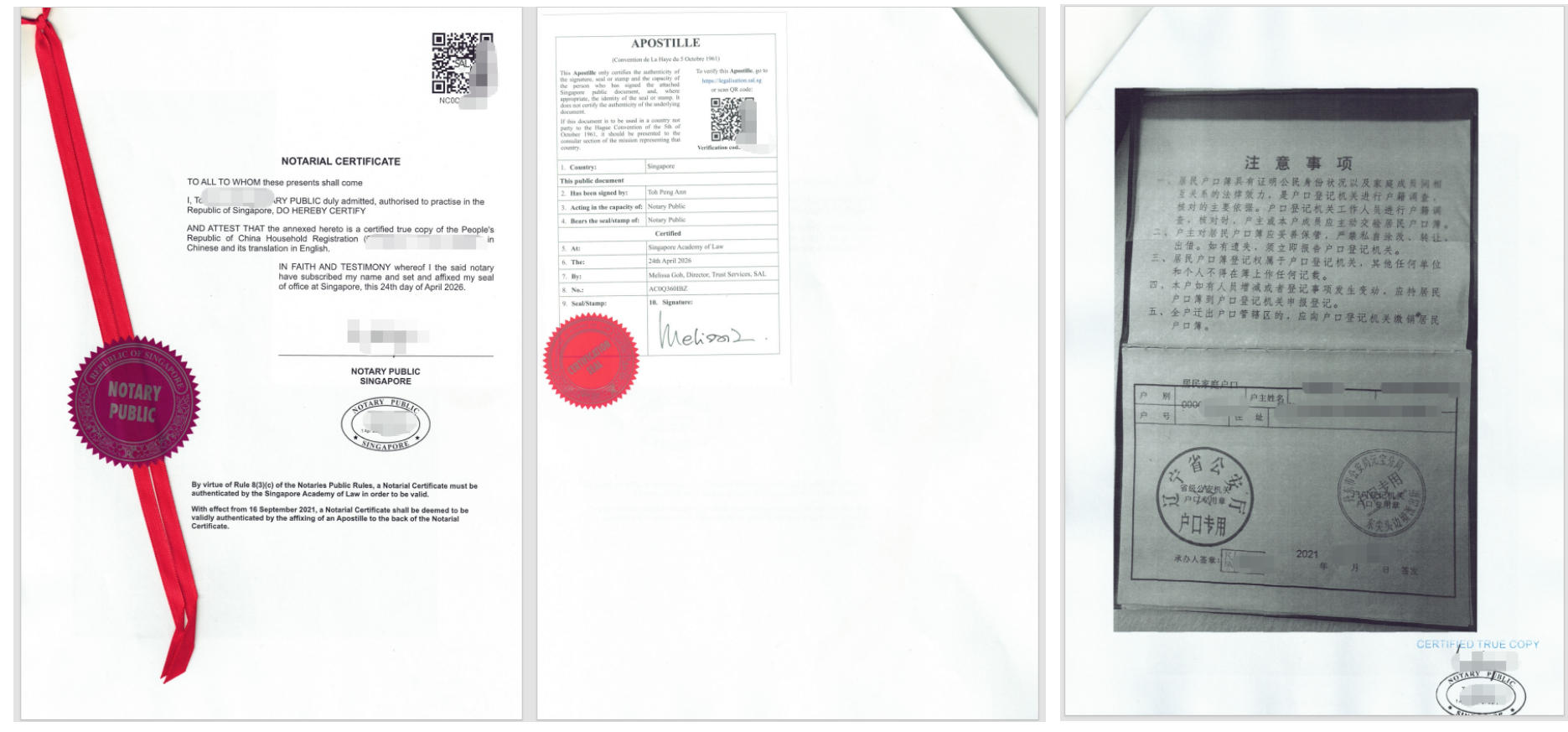
China household registration booklet after translation, notarization, and apostille — complete bilingual document package (example)
4. Timeline
Translation + Notarization + Apostille
3–5
business days
With embassy legalization
+3
additional business days
Urgent processing
—
Contact us to enquire
Lervice offers standardized, transparent pricing — no hourly legal consultation fees. Contact us directly for a quote.
5. Frequently Asked Questions
1. Do I need to send the original hukou booklet?
No. A clear, complete PDF scan is sufficient — no physical original needs to be posted. Please ensure the scan quality is clear and all text and official stamps are legible.
2. Is the entire booklet required, or just the relevant pages?
The entire booklet is required. The pages of a household registration booklet are interconnected, and submitting only selected pages may prevent the receiving authority from verifying the complete family relationship. Please provide a full PDF scan including the household head page and all member pages.
3. The applicant and sponsor are in different hukou booklets — how is this handled?
Both complete hukou booklets must be provided as PDFs. We will bind the content and translations of both booklets into a single notarization booklet, using both to jointly establish the family relationship between the applicant and sponsor. Please contact us to describe your specific situation and we will confirm exactly what needs to be included.
4. The hukou has changed since registration (e.g. someone has moved out) — does it need to be updated first?
It depends on the nature of the change and what the receiving authority requires. If the existing information in the hukou is sufficient to establish the required family relationship, an update is generally not needed. If the applicant themselves has been deregistered from the booklet, please contact us to explain the situation — we will help determine the most appropriate way to proceed.
5. Can I get copies of the notarized document?
No. Singapore notarizations are issued as originals only — no certified copies are produced. If you need multiple sets, each must be ordered and paid for separately. We recommend confirming the number of sets you need before placing your order.
6. How long is the certification valid? Will ICA require a "recent" document?
The notarization itself has no expiry date, but ICA and similar authorities typically require documents issued within a certain period (such as within the past 6 or 12 months). We recommend confirming ICA's specific requirement before placing your order, to avoid having to redo the process due to timing.
6. When Is Hukou Notarization Required?
Here are the most common situations that require a notarized and apostilled Chinese household registration booklet:
Not sure what documents you need, or processing multiple documents at once?
Contact our team, describe your application type and family situation, and we'll confirm the complete document checklist for you.