Singapore Corporate Power of Attorney Notarization and Apostille: Complete Guide
When a Singapore company needs to authorize a representative to handle legal matters, sign contracts, manage banking affairs, or deal with other important business abroad on the company's behalf, a notarized and apostilled corporate power of attorney is the document that gives the authorized representative the legal standing to act for the company in a foreign jurisdiction. This guide explains the process, what documents you need to prepare, and how a corporate power of attorney differs from a personal one.
1. Key Rules for Corporate Power of Attorney Notarization
A corporate power of attorney is a document issued by the company itself — it is not a government-issued certificate. It therefore cannot proceed directly to apostille and must first be notarized by a lawyer before the apostille can be applied.
How a corporate power of attorney differs from a personal one: A personal power of attorney is issued in the name of an individual, signed by that individual, and only requires a copy of that person's identity document as supporting material. A corporate power of attorney is issued in the company's name, signed by a director authorized to represent the company, and requires company documents — specifically the Bizfile — to prove that the signatory has the authority to bind the company.
2. Step-by-Step Process
Prepare POA and supporting documents
→
Director signs and submits to Lervice
→
Notarization by lawyer
→
Apostille
→
Translation (if required)
→
Collect or courier delivery
3. Documents Required
Main document
- Corporate power of attorney — signed original: Signed by a director authorized to represent the company. The director does not need to appear in person — the signed original can be submitted by courier.
- The document should clearly state the scope of authority, the attorney-in-fact's details, and the validity period. Contact us if you need a reference template.
Supporting documents
- Company Business Profile (Bizfile): The latest version downloaded from ACRA, used to confirm that the signatory is a current director of the company and that the company is validly registered
- Copy of each signing director's identity document: A copy of the identity document matching the information on the Bizfile (e.g. Singapore passport, NRIC)
Why are the Bizfile and identity documents required? The notarizing lawyer needs to verify two things: that the signatory is a current director of the company and therefore has the authority to sign on the company's behalf; and that the signatory's identity matches the information recorded on the Bizfile. Together, these two documents provide both layers of verification needed for the notarization to proceed.
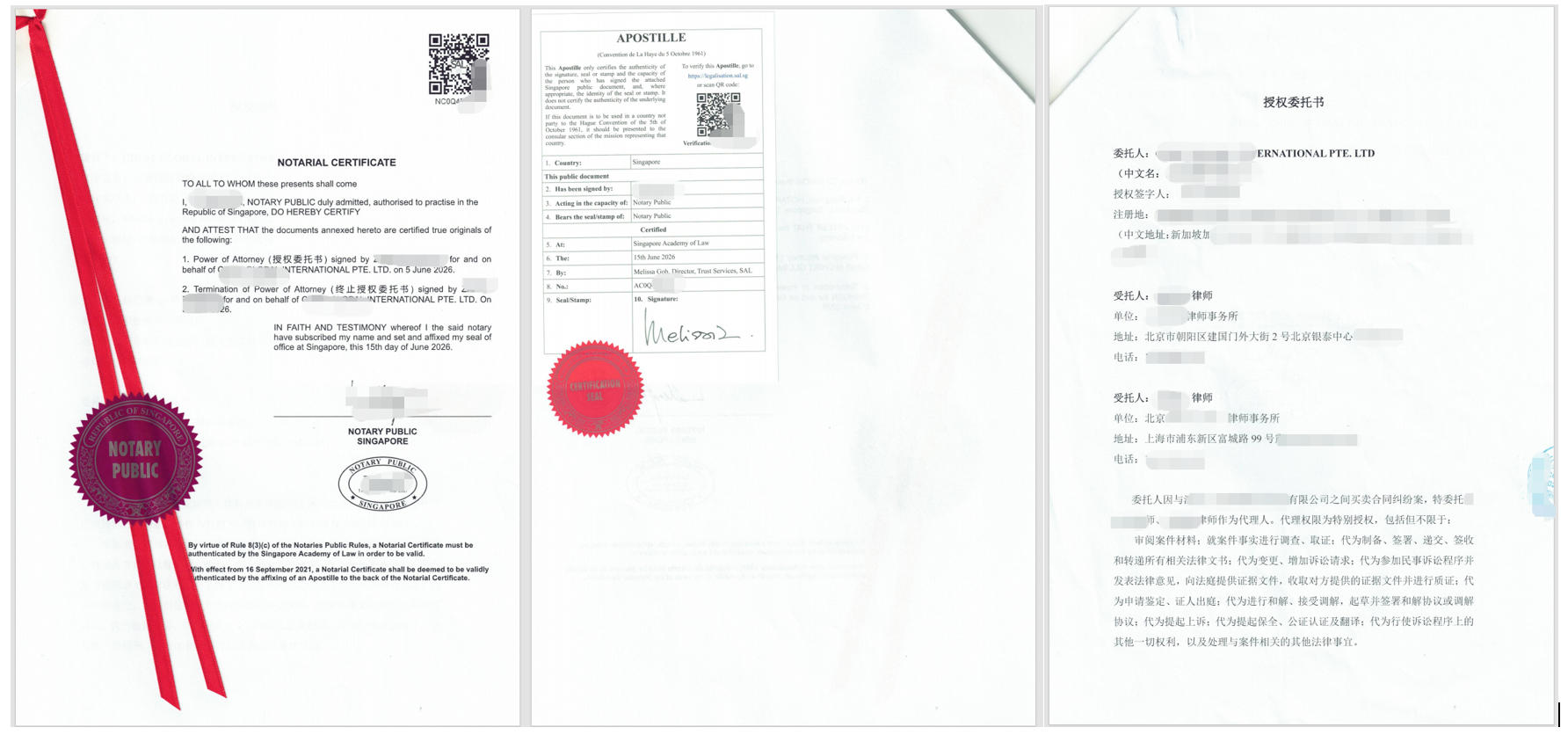
Singapore corporate power of attorney after notarization and apostille — completed document package (example)
4. Corporate Powers of Attorney Are Usually Submitted with Other Company Documents
In practice, foreign institutions typically require a corporate power of attorney and company registration documents (such as the COI and Bizfile) to be submitted together as a complete corporate authorization package. All documents can be bound together in a single notarization booklet and apostilled together, saving time and cost.
In this case, the Bizfile serves a dual purpose within the same notarization booklet — as a supporting document verifying the signing director's authority, and as a company registration document in its own right.
Important — if embassy legalization is also required: If the documents ultimately need to go through embassy legalization in addition to apostille, some embassies require each document to be presented as a separate, independent notarization and will not accept combined booklets. If embassy legalization may be needed for your destination country, please let us know before proceeding so we can advise on whether documents should be processed separately to avoid having to redo them.
5. Timeline
Notarization + Apostille
2–3
business days
With embassy legalization
+3
additional business days
With CN-EN translation
+3–5
additional business days
Lervice offers standardized, transparent pricing. Contact us directly for a quote.
6. Frequently Asked Questions
1. Does the director need to appear in person to sign?
No. The director simply needs to sign the power of attorney and courier the signed original to our office. No in-person attendance is required at any stage.
2. What is the difference between a corporate power of attorney and a board resolution, and when are both required?
A board resolution confirms that the company's board of directors has made a collective decision on a particular matter. A corporate power of attorney specifically authorizes a named individual to carry out defined tasks on the company's behalf. Some foreign institutions — particularly banks — require both documents: the resolution to confirm the authorization decision, and the power of attorney to specify who is authorized and what they can do. We recommend confirming the specific requirements with the receiving institution before proceeding.
3. Can the power of attorney authorize multiple people or cover multiple matters?
Yes. A single corporate power of attorney can name multiple attorneys-in-fact and cover multiple authorized matters. We recommend drafting the document as specifically as possible to avoid vague wording that might cause a foreign institution to reject it. Contact us if you need help with the drafting.
4. Can it be combined with the COI and Bizfile in one notarization? Are there restrictions when embassy legalization is involved?
In most cases, yes — combining all documents in one notarization is recommended as it saves time and cost. However, if the documents subsequently need to go through embassy legalization, some embassies require each document to have been independently notarized and will not accept a combined booklet. If your documents may need embassy legalization, please let us know in advance and we will advise on the appropriate approach for your destination country.
5. Can I get copies of the notarized document?
No. Singapore notarizations are issued as originals only — no certified copies are produced. If you need multiple sets, each must be ordered and paid for separately. We recommend confirming the number of sets needed before placing your order.
6. How long is the power of attorney valid?
The notarization itself has no expiry date, but the validity period of the power of attorney is typically stated within the document itself (for example, "valid for one year from the date of signing"). Some foreign institutions also require documents to have been issued within a certain period. We recommend specifying a clear validity period in the document and confirming the receiving institution's requirements before proceeding.
7. The document is for use in a country that has not joined the Hague Convention — is embassy legalization required?
Yes. If the document needs to be used in a country that is not a Hague Convention member, consular legalization at the relevant country's embassy will be required. Some embassies also have specific requirements about how documents are presented — for example, requiring each document to be independently notarized rather than combined. Please contact us with your destination country so we can advise on the most appropriate approach before you proceed.
7. When Is a Corporate Power of Attorney Certification Required?
Here are the most common situations that require a notarized and apostilled corporate power of attorney:
Need help drafting the power of attorney, or not sure which supporting documents are required?
Contact our team, describe your business purpose and destination country, and we'll confirm the right approach for you.