Singapore Audit Report & Financial Statements Notarization and Apostille: Complete Guide
When opening a foreign bank account, signing an investment agreement, registering an overseas subsidiary, or fulfilling cross-border compliance requirements, foreign institutions often require a notarized and apostilled audit report or financial statements to verify the company's financial standing and compliance status. This guide explains the notarization and apostille process for audit reports and financial statements, what you need to prepare, and the difference between submitting originals and scans.
1. What Does the Notarization Actually Certify?
Notarization of an audit report or financial statements works the same way as for other documents — the notary lawyer certifies that the document is a true original or true copy, rather than verifying the accuracy of the financial figures or the auditor's conclusions. After notarization, the document proceeds to apostille, and the complete certified package can then be submitted to the foreign institution.
Both originals and scans are accepted. Unlike bank statements, audit reports and financial statements can be submitted as high-resolution scans of paper documents — the original electronic file is not required. When a scan is submitted, the notarization certificate states that the document is a "true copy"; when the original electronic file is submitted, it states "true original." Both are widely accepted by foreign institutions.
2. Step-by-Step Process
Submit audit report / financial statements
→
Lervice reviews the document
→
Notarization (true original / true copy)
→
Apostille
→
Collect or courier delivery
3. Documents Required
- Audit report and/or financial statements: Original or high-resolution scan both accepted. If submitting a scan, please ensure all pages, signatures, and stamps are clearly legible.
- Company Business Profile (Bizfile): The latest version downloaded from ACRA, submitted as a supporting document to confirm the company's legal registration
Audit report and financial statements can be combined in one notarization. If the receiving institution requires both the audit report and financial statements, the two documents can be bound together in a single notarization booklet and apostilled together — saving time and cost. Please let us know which documents need to be combined when submitting.
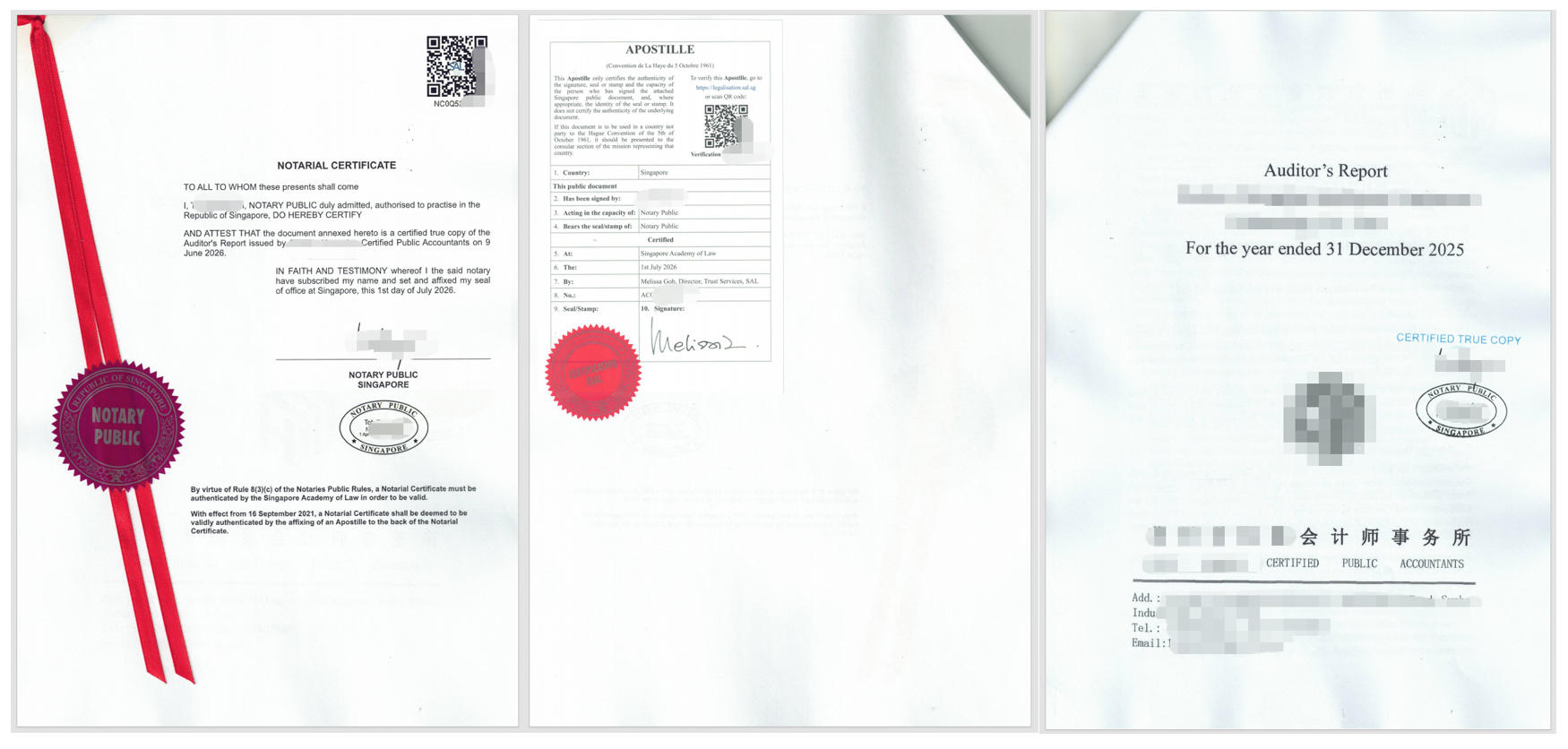
Singapore company audit report after notarization and apostille — completed document package (example)
4. Timeline
Notarization + Apostille
2–3
business days
With embassy legalization
+3
additional business days
Urgent processing
—
Contact us to enquire
Lervice offers standardized, transparent pricing. Contact us directly for a quote.
5. Frequently Asked Questions
1. What exactly does the notarization certify? Does the notary verify that the financial figures are accurate?
No. The notary lawyer certifies the authenticity of the document itself — that the audit report or financial statements you have provided are a genuine original or true copy that has not been falsified or altered. The notarization certificate states that the document is a "true original" or "true copy." It does not verify, validate, or endorse the financial figures, the auditor's conclusions, or the company's financial position in any way.
2. Can I submit a scan? What is the difference from submitting the original?
Yes, scans are accepted. When the original is submitted, the notarization certificate states "true original"; when a scan is submitted, it states "true copy." Both are accepted by the majority of foreign institutions. If you are unsure which format the receiving institution prefers, we recommend checking with them first — or submitting the original to be on the safe side.
3. Which financial years' audit reports do I need to certify?
This depends on the receiving institution's requirements. The most common requirement is the most recent 1 to 2 financial years, though some institutions may require up to 3 years. We recommend confirming the required years with the receiving institution before submitting, so all necessary documents can be processed in one go.
4. Can the audit report and financial statements be combined in the same notarization?
Yes. Both documents can be bound together in a single notarization booklet and apostilled together, which is generally more economical than processing them separately. If other company documents also need to be certified at the same time (such as the COI or Bizfile), those can be included in the same package as well. Please let us know all the documents you need when placing your order.
5. Audit reports can be very long — will this affect the cost?
It may. Notarization fees can vary depending on the number of pages in the document. Audit reports are often lengthy, so we recommend informing us of the approximate page count before submitting so we can provide an accurate quote. If the receiving institution only requires specific sections (such as a summary of financial statements), it may be possible to certify only the required portions — please let us know.
6. Can I get copies of the notarized document?
No. Singapore notarizations are issued as originals only — no certified copies are produced. If you need multiple sets, each must be ordered and paid for separately. We recommend confirming the number of sets needed before placing your order.
7. The document is for use in a country that has not joined the Hague Convention — is embassy legalization required?
Yes. If the document needs to be used in a country that is not a Hague Convention member, the apostille will not be recognized there and consular legalization at the relevant country's embassy will be required. Please contact us with the destination country and we will advise whether embassy legalization is needed and how to arrange it.
6. When Is Audit Report or Financial Statements Certification Required?
Here are the most common situations that require notarized and apostilled audit reports or financial statements:
Not sure which years to certify, or need to process multiple company documents at once?
Contact our team, tell us your purpose and destination country, and we'll confirm the right approach for you.