Singapore Renunciation of Inheritance Notarization & Apostille: Complete Guide
When a family member passes away leaving assets abroad and you, as one of the legal heirs, wish to give up your share of the inheritance so that other heirs can proceed with the transfer or disposal independently, a notarized and apostilled renunciation of inheritance declaration is the formal legal document that foreign authorities require as proof of your intention to renounce. This guide explains the process, what you need to prepare, and answers to the most common questions.
1. Key Rules for Renunciation of Inheritance Notarization
A renunciation of inheritance declaration is a private legal document prepared by the renouncing party. It must be notarized by a lawyer before apostille — it cannot proceed directly to apostille. Only the renouncing party needs to sign. No participation or signature from other heirs is required.
The declaration can be drafted in any appropriate language. If the document is intended for use in a Chinese-speaking jurisdiction, it can be drafted entirely in Chinese with no English translation needed. For use in other countries, the language requirements may differ — please let us know your destination country in advance and we will advise accordingly.
2. Step-by-Step Process
Prepare declaration and documents
→
Lervice reviews your documents
→
Notarization by lawyer
→
Apostille
→
Translation (if required)
→
Collect or courier delivery
3. Documents Required
- Renunciation of inheritance declaration: You may draft this yourself or contact us for a reference template. Only the renouncing party needs to sign — no signatures from other heirs are required.
- Copy of the declarant's identity document: Provide a copy of whichever identity document is referenced in the declaration (e.g. Singapore passport, NRIC)
The declaration and identity document copy are bound together in a single notarization booklet, then apostilled to produce a complete certified document ready for submission.
How to submit the signed declaration: Three options are available — appear in person to sign before the lawyer; courier the signed original to our office; or provide a high-resolution scan (with the original also sent by post for the lawyer to verify). Choose whichever is most convenient.
If a translation is required: Some receiving authorities require the entire notarization booklet and apostille certificate to be translated into the local language. Lervice works with qualified translation partners and can arrange this end-to-end — the final delivery will include the original notarized and apostilled document plus the translated version. Please let us know your destination country and we will advise whether a translation is needed and what form it should take.
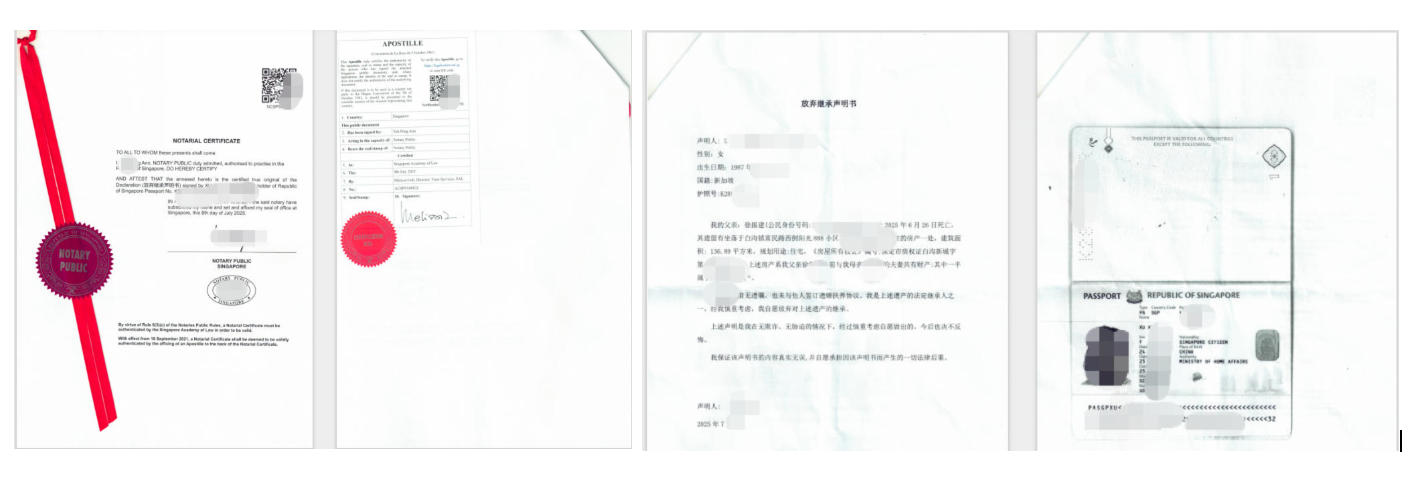
Renunciation of inheritance declaration after notarization and apostille — completed document package (example)
4. Timeline
Notarization + Apostille
2–3
business days
With translation
+3–5
additional business days
With embassy legalization
+3
additional business days
Lervice offers standardized, transparent pricing — no hourly legal consultation fees. Contact us directly for a quote.
5. Frequently Asked Questions
1. Do I need to appear in person to sign the declaration?
No — there are three options. You can appear in person to sign before the lawyer; courier the signed original to our office; or provide a high-resolution scan (with the original also sent by post for verification). Choose whichever is most convenient for your situation.
2. Do other heirs need to be involved or sign anything?
No. A renunciation of inheritance declaration only requires the signature of the person renouncing their share. Other heirs do not need to participate, sign, or provide any documents.
3. What information does the declaration need to include?
The declaration should typically state: the declarant's personal details (name and identity document number); the deceased's personal details (name and relationship to the declarant); a clear statement of voluntary renunciation of the inheritance; and the date of signing. If you are unsure how to draft this, contact us for a reference template.
4. Is a death certificate required for the notarization?
No. The Singapore notarization process does not require a death certificate. The death certificate is a document that the estate-handling authority (such as a notary office or court) will request when reviewing the overall estate materials — it is not part of the Singapore notarization and apostille process.
5. Can I get copies of the notarized document?
No. Singapore notarizations are issued as originals only — no certified copies are produced. If you need multiple sets, each must be ordered and paid for separately. We recommend confirming the number of sets you need before placing your order.
6. How long is the certification valid? Will authorities require a "recent" document?
The notarization itself has no expiry date, but some receiving authorities require documents issued within a certain period. We recommend confirming the time requirement with the relevant authority before placing your order to avoid having to redo it.
7. I'm not in Singapore — can I handle this remotely?
Yes. Courier the signed declaration original to our Singapore office together with a copy of your identity document. Once the process is complete, we will courier the certified documents to your address. No in-person visit is needed at any stage.
6. When Is a Renunciation of Inheritance Declaration Required?
Here are the most common situations that require a notarized and apostilled renunciation of inheritance:
Not sure how to draft the declaration or what documents you need?
Contact our team, describe the estate situation and purpose, and we'll confirm the right approach for you.