Singapore Litigation Documents Notarization & Apostille: Complaint & Letter of Engagement Complete Guide
When you are based in Singapore and need to initiate legal proceedings or appoint a lawyer to represent you in a foreign court, the court and law firm will typically require your legal documents to be notarized and apostilled before they can be formally accepted. Whether it is a letter of engagement authorizing a lawyer to act on your behalf, or a complaint to be filed with the court, these documents must be notarized in Singapore before being submitted to your lawyer or the court abroad. This guide explains the complete process and what you need to prepare.
1. Key Rules for Litigation Document Notarization
Complaints and letters of engagement are legal documents that cannot proceed directly to apostille — they must first be notarized by a lawyer, then apostilled, before they will be formally accepted by foreign courts or legal institutions.
Documents are typically drafted by your appointed lawyer. Complaints and letters of engagement are generally prepared by the lawyer handling your case. Once you have signed the documents, you submit them to us for notarization and apostille. If you have not yet appointed a lawyer, we recommend doing so and obtaining the draft documents before contacting us to arrange notarization.
Documents can be drafted in any appropriate language. For proceedings in a foreign jurisdiction, the documents are typically drafted in the language of that jurisdiction — no translation into English or any other language is required for the notarization itself. If the receiving court or institution has specific language requirements, please confirm with your lawyer beforehand.
2. Step-by-Step Process
Lawyer drafts documents
→
Client signs and submits to Lervice
→
Notarization by lawyer
→
Apostille
→
Collect or courier to lawyer / court
3. Documents Required
- Complaint and/or letter of engagement: Drafted by your appointed lawyer, signed by you, then submitted to us
- Copy of the client's identity document: Provide a copy of whichever identity document is referenced in the documents (e.g. Singapore passport, NRIC)
The legal documents and identity document copy are bound together in a single notarization booklet, then apostilled to produce a complete certified package ready to be sent to your lawyer or court abroad.
How to submit the signed documents: Three options are available — appear in person to sign before the lawyer; courier the signed originals to our office; or provide a high-resolution scan (with the originals also sent by post for the lawyer to verify). If your case has a tight deadline, we recommend appearing in person or couriering the originals to ensure the fastest processing.
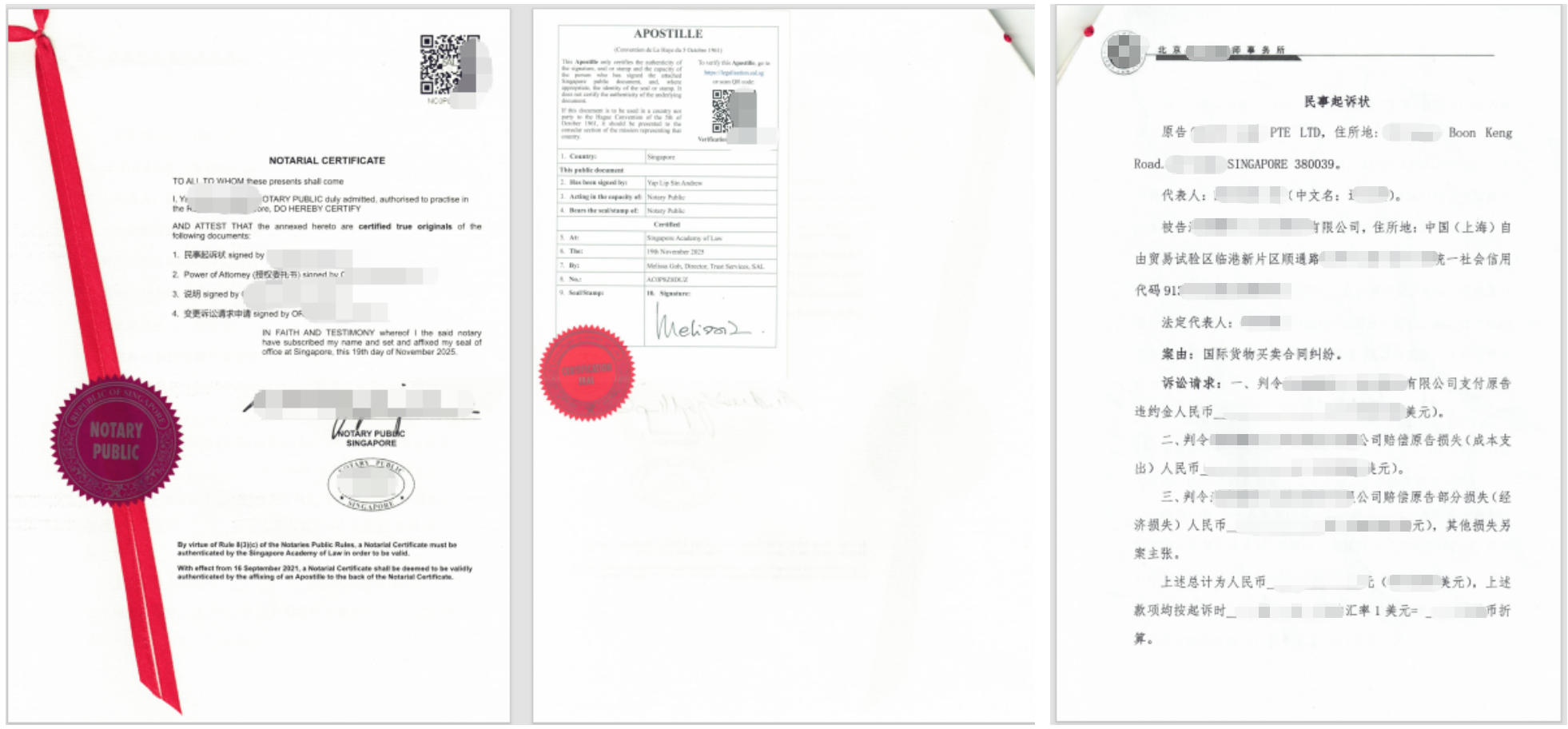
Letter of engagement after notarization and apostille — completed document package (example)
4. Timeline
Notarization + Apostille
2–3
business days
With embassy legalization
+3
additional business days
Urgent processing
—
Contact us to enquire
Legal proceedings often have strict deadlines. If you need urgent processing, please contact us in advance with your deadline and we will do our best to accommodate your timeline. Contact us for a quote.
5. Frequently Asked Questions
1. Can the complaint and letter of engagement be combined in one notarization?
Yes. If both documents need to be certified at the same time, they can be bound together in a single notarization booklet and apostilled together — saving time and cost. Please let us know when you submit your documents and we will arrange this.
2. Do I need to appear in person to sign?
No — there are three options. You can appear in person to sign before the lawyer; courier the signed originals to our office; or provide a high-resolution scan (with the originals also sent by post for verification). If your case has a tight deadline, appearing in person or couriering the originals is recommended to avoid any delays.
3. Will the foreign lawyer or court require additional documents?
Our role is to handle the notarization and apostille — ensuring your signed documents are certified by a Singapore lawyer and carry an apostille, giving them legal standing abroad. The foreign lawyer or court may require additional supporting materials (such as identity documents or evidence). Please confirm these requirements with your appointed lawyer separately, as they are independent of the notarization process.
4. Can I get copies of the notarized document?
No. Singapore notarizations are issued as originals only — no certified copies are produced. If you need multiple sets (for example, to submit to both the court and the law firm), each must be ordered and paid for separately. We recommend confirming the number of sets needed before placing your order.
5. How long is the certification valid? Will the court impose a time limit?
The notarization itself has no expiry date, but courts and law firms may require documents issued within a certain period. We recommend confirming the court's specific requirements with your lawyer before arranging notarization, to avoid having to redo it due to timing issues.
6. I'm not in Singapore — can I handle this remotely?
Yes. Courier the signed document originals to our Singapore office together with a copy of your identity document. Once the process is complete, we can courier the certified documents to your address or directly to your lawyer. No in-person visit is needed at any stage.
6. When Are Litigation Documents Required to Be Notarized?
Here are the most common situations that require notarized and apostilled litigation documents:
Have litigation documents that need notarization and apostille?
Contact our team, let us know the document type and your deadline, and we'll arrange processing as quickly as possible.