Singapore Invoice & Contract Notarization and Apostille: Complete Guide
When initiating legal proceedings abroad, submitting evidence to arbitration, or resolving cross-border commercial disputes, foreign courts, arbitration bodies, and counterparties often require notarized and apostilled invoices or contracts to establish the authenticity and legal standing of the documents in question. This guide explains the notarization and apostille process for Singapore company invoices and contracts, and what you need to prepare.
1. What Does the Notarization Actually Certify?
Notarization of an invoice or contract works the same way as for audit reports and bank statements — the notary lawyer certifies that the document is a true original or true copy, rather than verifying the content, the validity of the transaction, or the terms of the contract. After notarization, the document proceeds to apostille, and the complete certified package can then be submitted as legal evidence to the foreign institution.
Both originals and scans are accepted. Invoices and contracts can be submitted as high-resolution scans of paper documents — the original electronic file is not required. When a scan is submitted, the notarization certificate states "true copy"; when the original electronic file is submitted, it states "true original." Both are widely accepted by foreign courts and institutions. Submitting a scan also allows you to retain the original for other uses — which can be important when original documents may be needed in ongoing proceedings.
2. Step-by-Step Process
Submit invoice / contract
→
Lervice reviews the document
→
Notarization (true original / true copy)
→
Apostille
→
Collect or courier delivery
3. Documents Required
- Invoice and/or contract: Original or high-resolution scan both accepted. If submitting a scan, please ensure all pages, signatures, stamps, and key terms are clearly legible.
- Company Business Profile (Bizfile): The latest version downloaded from ACRA, submitted as a supporting document to confirm the company's legal registration
Multiple documents can be combined in one notarization. If several invoices or contracts need to be certified at the same time, they can be bound together in a single notarization booklet and apostilled together — generally more economical than processing each separately. Other company documents can also be included in the same package. Please let us know all the documents you need when submitting.
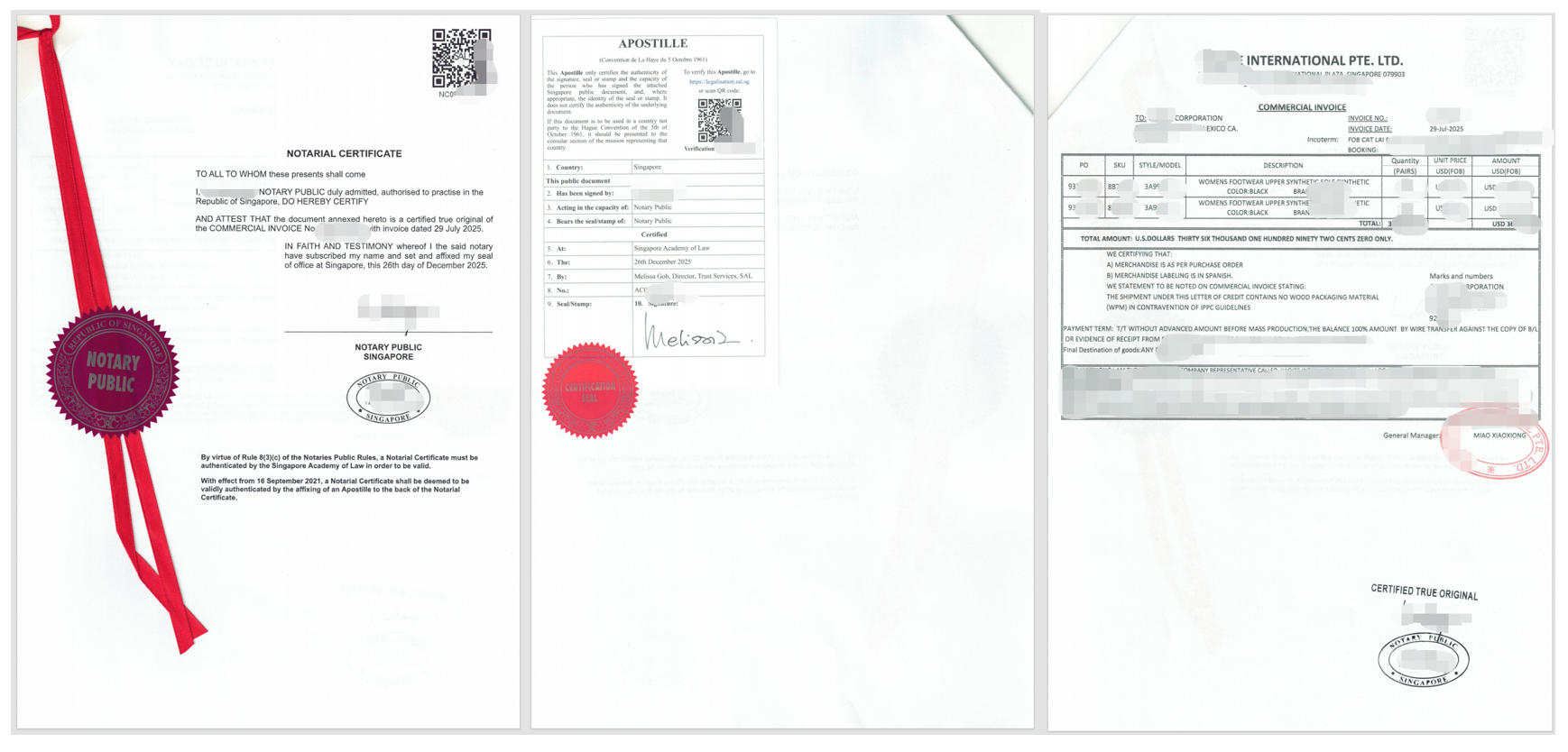
Singapore company contract after notarization and apostille — completed document package (example)
4. Timeline
Notarization + Apostille
2–3
business days
With embassy legalization
+3
additional business days
Urgent processing
—
Contact us to enquire
Legal proceedings and arbitration often have strict deadlines. If you need urgent processing, please contact us in advance with your deadline and we will do our best to prioritize your order. Contact us for a quote.
5. Frequently Asked Questions
1. What exactly does the notarization certify? Does the notary verify that the contract terms are legally valid?
No. The notary lawyer certifies the authenticity of the document itself — that the invoice or contract you have provided is a genuine original or true copy that has not been falsified or altered. The notarization certificate states that the document is a "true original" or "true copy." It does not verify the content of the document, the validity of the transaction, the legality of the contract terms, or whether either party has performed their obligations.
2. Can I submit a scan? What is the difference from submitting the original?
Yes, scans are accepted. When the original is submitted, the notarization certificate states "true original"; when a scan is submitted, it states "true copy." Both are accepted by the majority of foreign courts and institutions. If you need to keep the original in hand — for example, because it may be needed as a physical exhibit during ongoing proceedings — submitting a scan for notarization is the more practical choice.
3. Can multiple invoices or contracts be combined in the same notarization?
Yes. Multiple related invoices or contracts can be bound together in a single notarization booklet and apostilled together, which is generally more economical than processing each one separately. However, if different documents need to be submitted to different institutions, they should be processed separately so each can be submitted independently. Please let us know your specific requirements when placing your order.
4. Contracts can be very long — will this affect the cost?
It may. Notarization fees can vary depending on the number of pages. If the contract is lengthy, we recommend informing us of the approximate page count before submitting so we can provide an accurate quote. If the foreign institution only requires specific sections of the contract (such as certain key clauses), it may be possible to certify only the relevant portions — please contact us to discuss your specific needs.
5. Can I get copies of the notarized document?
No. Singapore notarizations are issued as originals only — no certified copies are produced. If you need multiple sets (for example, to submit to more than one institution), each must be ordered and paid for separately. We recommend confirming the number of sets needed before placing your order.
6. How long is the certification valid? Will the court impose a time limit?
The notarization itself has no expiry date, but some courts or institutions may require documents to have been certified within a certain period. For documents being used in active legal proceedings, we recommend arranging certification in a timely manner during the course of the case to avoid having to redo it if too much time passes before submission.
7. The document is for use in a country that has not joined the Hague Convention — is embassy legalization required?
Yes. If the document needs to be used in a country that is not a Hague Convention member, the apostille will not be recognized there and consular legalization at the relevant country's embassy will be required. Please contact us with the destination country and we will advise whether embassy legalization is needed and how to arrange it.
6. When Is Invoice or Contract Certification Required?
Here are the most common situations that require notarized and apostilled invoices or contracts:
Need to certify invoices or contracts as legal evidence, or not sure what documents are required?
Contact our team, describe your case, destination country, and deadline, and we'll arrange processing as quickly as possible.